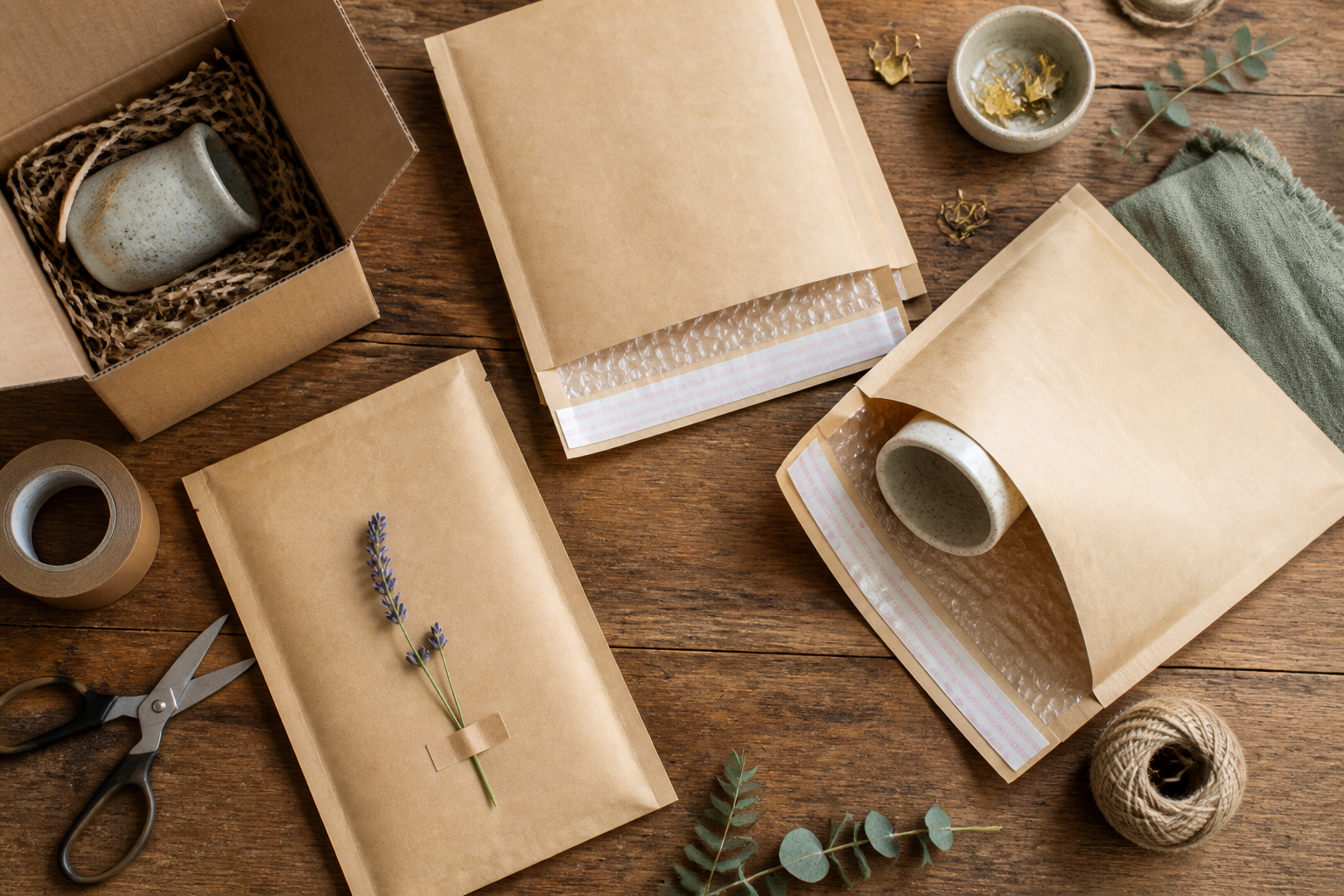
How kraft bubble mailers help eco-conscious brands cut plastic without losing protection
Key Takeaways
Match the mailer size to the product first — a #0 kraft bubble mailer fits jewelry fine, but mugs and candles need at least a #4 or #5 to avoid crushing.
Expect kraft bubble mailers to run a bit more than plain poly per unit, but bulk case pricing brings the cost close enough that the eco upgrade rarely hurts margins.
Check the label before assuming recyclability — a true paper-and-bubble kraft mailer with no foil lining recycles far more easily than a hybrid poly-lined version.
Weigh a packed 6×9 or 9×12 mailer before printing postage; USPS charges by weight and size, and guessing wrong means paying for a reprint or getting a package bounced back.
Reinforce corners and double up padding around glass, ceramic, or jewelry pieces — the bubble layer helps, but it's not a substitute for wrapping fragile items separately inside.
Buy in bulk once order volume climbs past a few dozen a month, since per-mailer cost drops fast and running out mid-shipping-season costs more than the case itself.
A ceramic mug wrapped in three feet of bubble wrap, stuffed into a plain plastic envelope, sealed with tape that'll outlive us all. Sound familiar? A decade ago that was standard practice for anyone shipping handmade goods. Buyers are done with it. They want their favorite candle or hand-thrown bowl to show up in one piece — but they also want the packaging to disappear into a compost bin instead of a landfill for the next 400 years.
That tension is exactly why kraft bubble mailers have taken over so much shelf space in Etsy sellers' supply closets. They look like a paper envelope, but there's a cushioned lining doing real work underneath — enough to protect a coffee mug or a pair of earrings without the crinkle and shine of plastic. Buyers notice the difference the second the package lands on their porch, and honestly, so do sellers checking their return rates.
Here's what most handmade sellers get wrong at first: they assume going eco-friendly means giving up protection, or paying double for it. Neither is true — not anymore. The honest answer is that kraft bubble mailers now come in enough sizes and thicknesses that jewelry, mugs, framed prints, and even small home decor pieces can all ship safely without a single sheet of plastic bubble wrap involved. What matters is knowing which size and which build actually fit what you're selling.
What A Kraft Bubble Mailer Actually Is (And Why It's Not Just A Brown Envelope)
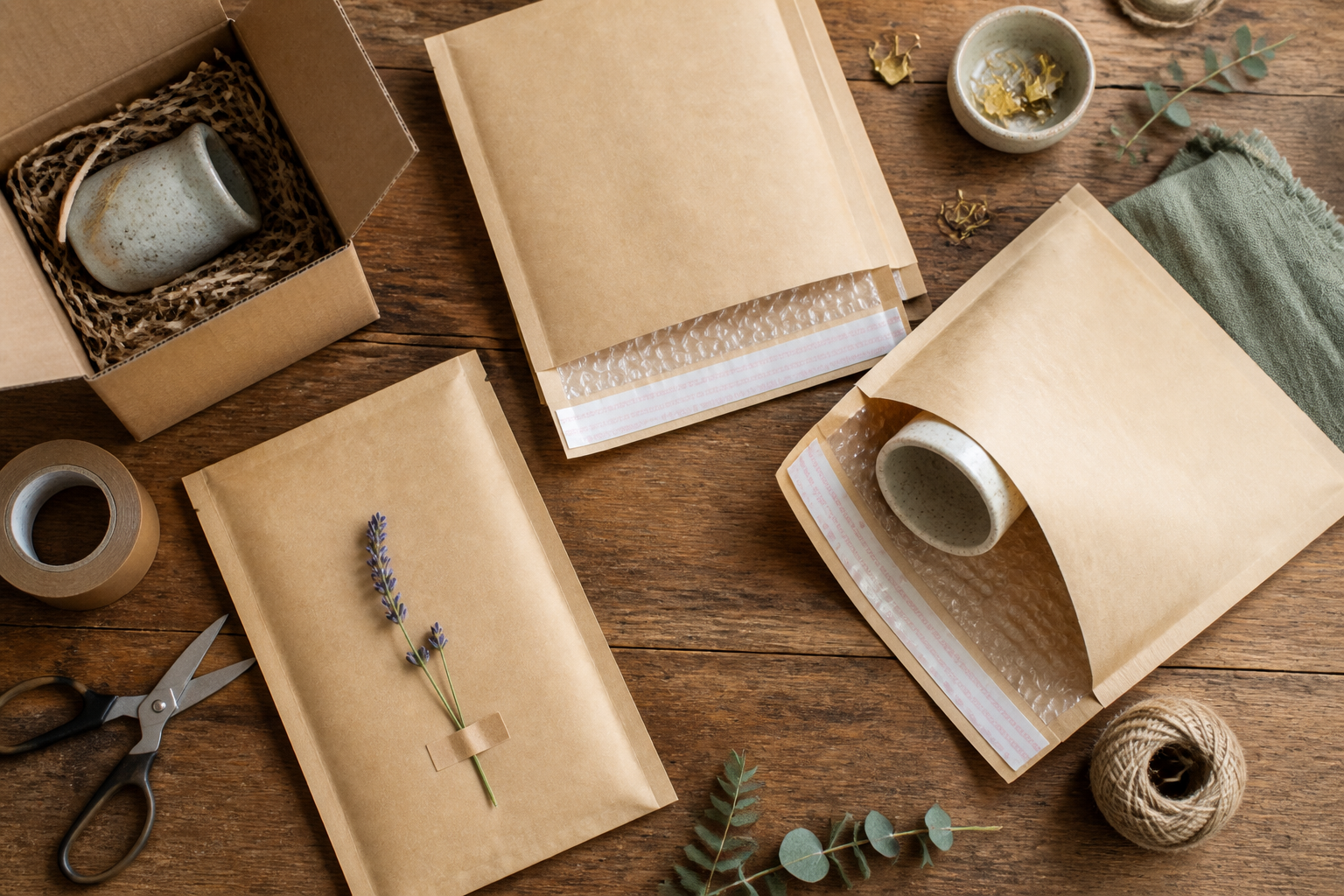
Picture a Saturday morning packing table: a ceramic mug, a strip of tape, and a pile of leftover plastic mailers that feel wrong for a handmade shop's brand. That's the moment most sellers discover kraft bubble mailers. Underneath the recycled paper shell sits a real cushioning layer — bubble film sandwiched between two sheets of kraft paper, not glued on as an afterthought.
That's the whole trick. It looks like a plain paper envelope but performs closer to a padded envelope you'd expect for glass or ceramics. The outer layer is genuine kraft stock (not laminated plastic dressed up brown), so it tears and recycles more easily than a standard poly bubble mailer.
Here's what most people miss: not every "kraft-look" mailer on the market actually contains bubble padding. Some are just kraft paper with a foam insert; others use thin poly bubble hidden inside heavier paper. Check the listing specs before buying in bulk — thickness and bubble diameter matter more than color.
Why Etsy Sellers Are Ditching Plain Poly For Kraft Bubble Mailers Right Now
Plastic mailers are losing their grip on the handmade market. Buyers on Etsy now ask sellers directly about packaging waste in reviews and messages — that never used to happen. Shops selling ceramics, jewelry, and small home goods are switching to kraft bubble mailers because they solve two problems at once: cushioning for fragile items and a paper-based outer layer that doesn't sit in a landfill for 400 years.
Here's what most people miss: this isn't just a feel-good swap. Kraft bubble mailer sizes now cover the same range as poly bubble mailers, from tiny 4×8 bubble mailers for earrings up to 10.5×16 for candles or mugs. Sellers who buy kraft bubble mailers wholesale or in bulk pay close to what they'd spend on plain poly bubble mailers, sometimes less once you factor in fewer damage claims.
Three shifts are driving this right now:
Rising customer expectation for recycled or recyclable mailing materials
Etsy's own seller guidance pushing sustainable packaging options
Buyers photographing unboxing for social posts — kraft just looks better
Plain poly still has a place. But for fragile, photogenic products, kraft's winning.
Kraft Bubble Mailer Sizes Explained: Matching #000 Through #7 To Your Product
Ever grabbed the wrong size mailer and ended up taping down half the envelope just to keep a candle from sliding around? Sizing is where most sellers waste money — either paying for extra postage on empty space or under-protecting a piece that needed more cushioning.
Small Padded Envelopes (3×3 To 5×8) For Jewelry And Tiny Crafts
A #000 (4×8) or smaller padded envelope works for earrings, rings, and thin charms. These keep first-class postage low and fit through most mail slots without a trip to the post office counter.
Mid-Size Mailers (6×9 To 9×12) For Mugs, Candles, And Apparel
The #2 (8.5×11) — #4 (9.5×14.5) sizes handle mugs, candles, folded apparel, and small home goods. These are the workhorse sizes — most Etsy shops stocking bulk kraft bubble mailers keep #2 and #4 on hand for daily orders.
Oversized Kraft Mailers (10.5×16 And Up) For Bulky Fragile Pieces
Framed art, larger ceramics, and multi-item bundles need a #5 or #6. Going a size up here beats stuffing a mailer to bursting — that's how seams split in transit.
Kraft Vs. Poly Bubble Mailers: Protection, Cost, And Look Compared
Here's a number that surprises most sellers: standard poly mailers take somewhere around 20 years to break down in a landfill, while a plain kraft mailer without a plastic liner can decompose in weeks under the right conditions. That gap is why so many Etsy shops are rethinking their padded envelope stock this year.
When Poly Still Wins
Poly bubble mailers still beat kraft on pure weatherproofing. If you're shipping through humid regions or your packages sit on a porch for days, poly's water-resistant shell protects better than uncoated paper. They're also lighter per size, which matters when every ounce affects your postage at the post office.
When Kraft Wins
Kraft bubble mailers win on look and recyclability — customers can toss them in curbside paper recycling instead of hunting for a plastic drop-off bin. They also photograph better for unboxing content; the natural brown tone reads as handmade and intentional. For dry-goods shippers — jewelry, candles, small ceramics — kraft delivers comparable cushioning at a similar cost per unit, without the plastic guilt trip in your customer's inbox.
What Kraft Bubble Mailers Cost In Bulk And How Wholesale Pricing Actually Works
Here's a myth that needs killing: buying "eco-friendly" packaging always costs more. Not true — not when you buy smart. Per-unit pricing on kraft bubble mailers drops fast once you move from small retail packs to case quantities. A 25-pack bought individually runs high per envelope; a case of 250 cuts that number dramatically. That's just how wholesale packaging works, whether you're buying poly, kraft, or padded envelopes.
A few things shift the math:
Size matters — a #0 (6×9) mailer costs less than a #6 (12×16), obviously, but the percentage savings at bulk quantities is similar across sizes.
Case breaks — most suppliers price in tiers at 100, 250, and 500-unit thresholds. Buying just past a threshold often saves more than buying just under the next one.
Shipping on the mailers themselves — some suppliers fold that into pricing, others charge separately. Always check before comparing quotes side by side.
Realistically, sellers moving 200+ packages a month should be buying by the case, not the pack. Anything less and you're leaving margin on the table every single month.
Shipping Kraft Bubble Mailers Through USPS, UPS, And Other Carriers Without Overpaying
Picture a seller packing a 6×9 kraft bubble mailer full of ceramic earrings, sealing it up, then guessing at postage at the post office counter. That guesswork costs money. A padded mailer under 1 lb usually ships First-Class, while anything heavier gets bumped into Priority territory — and that jump can double the price fast.
Reading Postage By Weight And Size
Weigh the package first, not the box size. USPS and UPS both price padded envelopes by weight and thickness, not just dimensions. A #2 kraft bubble mailer holding jewelry might weigh 4 oz; the same size stuffed with a candle could hit 12 oz and cross a rate threshold. Buying a kitchen scale ($15 or less) pays for itself within a week of shipping.
Tracking, Address Labels, And Avoiding Rejected Packages
Skip plain stamps for anything with tracking value — a printed label with a barcode avoids delays and lost-package disputes. Three habits prevent rejected packages:
Print address labels instead of handwriting them
Keep the mailer under 3/4 inch thick for machine sorting
Avoid overstuffing, which flags packages for manual handling and slows delivery
Are Kraft Bubble Mailers Actually Recyclable? Sorting Fact From Marketing
Most kraft bubble mailers are not fully recyclable — and that's the part nobody puts on the product listing. The outer layer is genuine kraft paper, which recycles fine on its own. But the bubble cushioning inside is polyethylene film, the same plastic used in poly mailers and bubble wrap. Once paper and plastic are bonded together, curbside recycling programs generally reject the whole envelope. It's a mixed-material product wearing a paper costume.
Here's what actually happens with most versions sold on marketplaces and even wholesale sites: the paper shell is recyclable, the lining isn't, and separating them by hand isn't realistic for a seller shipping 200 orders a week.
What to check before buying in bulk:
Look for mailers labeled with recycled paper content percentages (30% and up is common)
Check if the inner cushioning is biodegradable padding rather than standard poly bubble
Avoid mailers with foam or styrofoam inserts — those never break down
Ask suppliers directly whether the product is curbside recyclable or drop-off only
Realistically, kraft bubble mailers beat plastic poly mailers on perception and partial recyclability, even if they're not a perfect solution yet.
Where To Buy Kraft Bubble Mailers Wholesale For A Growing Handmade Business
Ready to stop paying retail prices every time you run out of mailers? That's the question most Etsy sellers ask right around order number 200, once buying 25-packs stops making sense.
Retail multipacks work fine at low volume. But once you're shipping 15 to 20 orders a week, buying wholesale by the case — usually 100 to 250 units — cuts your per-unit cost significantly compared to small retail packs. Look for suppliers that sell kraft bubble mailers by the case rather than forcing you into pallet-sized commitments meant for warehouses.
A few things worth checking before you buy:
Sizing accuracy — confirm actual usable interior dimensions, not just the label size
Free or flat-rate shipping on the mailers themselves, since shipping costs on bulky bubble packaging add up fast
Recycled content — genuinely recyclable kraft outer material, not just kraft-colored plastic
Consistent stock so you're not scrambling between restocks
Online wholesale suppliers built for small business volume tend to fit this niche better than general retail marketplaces. Case quantities without pallet minimums mean you can grow into bulk pricing gradually — no warehouse required.
Packing A Fragile Item In A Kraft Bubble Mailer The Right Way
Roughly 23% of e-commerce returns trace back to damage in transit, and a big chunk of that comes down to sellers treating a bubble mailer like a regular envelope. It's not. Here's the honest answer: kraft bubble mailers protect well only when you pack them with intent.
Start with the item wrapped in a layer of kraft paper or tissue — never let jewelry or ceramics touch the bubble lining directly, since sharp edges puncture the cushioning fast. Then follow these steps:
Center the item so it doesn't shift toward the seal during shipping.
Fill dead space with crumpled kraft paper, not air — empty pockets let items bounce.
Press air out before sealing so the self-seal strip actually bonds.
Double-check the size — a 6×9 mailer for a 4×4 item invites shifting.
For anything with glass or ceramic components, add a second interior layer, even if that means sizing up. Cheap doesn't mean careless. A well-packed mailer beats an oversized box every time — lighter, cheaper to ship — just as protective when you do it right.
Frequently Asked Questions
Are kraft bubble mailers good?
For the right products, yes — really good. They combine a padded interior with a paper outer, so you get cushioning for small ceramics, jewelry, or candles without shipping a full box. Just don't expect them to protect anything over a pound or two of dense, breakable weight. That's a job for a box with proper void fill.
What is a kraft bubble mailer?
It's a padded shipping envelope with a brown paper exterior and a bubble cushioning layer glued inside. Think of it as the eco-friendlier cousin of the shiny white poly bubble mailer. Sellers like them because they look natural and rustic right out of the package — no extra wrapping paper needed to make the unboxing feel intentional.
Will USPS give you free bubble mailers?
Only for Priority Mail and Priority Mail Express shipments — and those are specific USPS-branded Tyvek mailers, not the kraft bubble mailers you'd buy for everyday orders. If you're shipping First-Class or Ground Advantage (which most small sellers do for cost reasons), you're buying your own mailers. That's just the reality of it.
Who sells the cheapest bubble mailers?
Pricing swings a lot based on quantity — buying a 25-pack from a retail shelf will always cost more per unit than ordering a case of 250 or 500 online. Wholesale suppliers that stock high volume typically beat marketplace sellers on a per-mailer basis once you're buying in bulk. If you're shipping more than 50 orders a month, it's worth doing the math on a case price instead of restocking small packs constantly.
What size kraft bubble mailer do I need for a 6×9 item?
A #0 (6×10) or #00 (5×10) will usually work if your item is genuinely flat and close to 6×9. But give yourself a little wiggle room — a mailer that's too tight will stress the seams and pop open in transit. When in doubt, size up one notch rather than forcing a snug fit.
How much does it cost to ship a 4×8 bubble mailer through USPS?
Ground Advantage pricing depends on weight and zone, but a lightweight 4×8 mailer under 4 ounces typically lands in the $4-5 range with tracking included. First-Class rates run a bit lower for anything under a pound. Always weigh your packed mailer before assuming — a few extra grams of packing material can bump you into a pricier tier.
Are kraft bubble mailers recyclable?
Here's the honest answer: it's mixed. The paper outer is recyclable, but the plastic bubble layer inside means most curbside programs won't accept the whole mailer as-is. Some brands now sell paper-cushioned mailers with no plastic film at all — worth looking into if full recyclability matters to your customers.
Kraft bubble mailers vs. poly bubble mailers — which is better?
Depends what you're selling.
Poly mailers hold up better against rain and rough handling because the exterior is water-resistant plastic. Kraft versions look nicer for handmade or gift-style brands and tend to feel more premium when a customer opens the mailbox. If weatherproofing matters more than aesthetics, go poly. If presentation is the priority, kraft wins.
Can I get custom-printed kraft bubble mailers for my Etsy shop?
Yes, most packaging suppliers offer custom printing on kraft bubble mailers, though minimum order quantities usually start around 250-500 units. That's a real commitment for a small shop, so it only makes sense once you're shipping consistently enough to use them before your product line changes. Until then, a simple sticker or stamp on a plain kraft mailer gets you 80% of the branding effect for a fraction of the cost.
Do kraft bubble mailers work for clothing and soft goods?
Honestly, they're overkill for most apparel. A plain poly mailer protects clothing from moisture and dirt just fine and costs less per unit since you're not paying for bubble cushioning you don't need. Save the padded kraft mailers for things that can actually break.
Switching packaging materials feels like a small decision until you realize it touches everything — your costs, your unboxing experience, your customer's first impression, even how a jar of candle wax survives a cross-country truck ride. Kraft bubble mailers solve a real problem for handmade sellers: they cut plastic use without asking sellers to gamble on breakage. Get the size right, tape the seams properly, and they hold up just as well as their poly counterparts for most craft goods (pottery and glass still deserve extra padding, no exceptions there).
The sellers doing this well aren't guessing. They're checking their average package weight, testing a few sizes before committing to a case, and buying in bulk once they know what fits. That's the whole game — matching the mailer to the product instead of forcing the product into whatever's on the shelf.
So before the next restock order goes in, pull three recent shipments and measure them. Then order a sample size range of kraft bubble mailers and pack a real product before committing to a full case. That one test will save more money than any spreadsheet ever could.